The PhD experience has been, for me, basically a series of existential crises. The problem with getting a PhD in the humanities is that you go all in on a very insecure future. You leave your friends, your family, your beloved town in the mountains, and you arrive in a swampy new city, missing everything you left behind. Professors warned you that the job market was terrible, that the jobs themselves were scarce, and that, even if you got the job, the workload was intense and poorly compensated, but you were too used to being the exception, the exceptional one who got the awards, the scholarships, the teaching positions, the acceptances to PhD programs, so you block it out. But then, each month that you spend in this new swampy town that you just can't quite love or feel at home in, reality sets in just a little bit more. As you see classes of PhDs graduate and only one might get "the job," or you watch people walk away from the program entirely and you're just a little envious, or you notice that the people who are getting "the jobs" are going up on the job market for 3-5 years before they get a position, you start to question and doubt everything. I mean, you've put ALL of your eggs in this basket, and its a shoddy basket. Meanwhile, while your future looks bleaker and more insecure, you watch your friends buy houses, travel, start families, etc. and you are plagued by FOMO. Again, professors warned me of this, but I just wasn't mentally prepared for it. Few people know this, but when I passed my exams, I reacted by hysterical sobbing. It all seemed so meaningless. I put so much stress and work into getting to this moment and it seemed like such a waste of time. Needless to say, I was not in a good or healthy place then. I wasn't in a good or healthy place for much of the last few years.
I've spent a lot of time in my PhD program looking back over my shoulder, turning into a pillar of salt, as I berated myself: I should have gone to U of A, because then I would have been close to my family and friends while I had these existential crises. I should have gone to Illinois State, because their program prioritizes teaching more and I now know I prefer teaching to research. I should have never gotten the damn PhD. I should have looked for jobs after the masters. I should have become a high school teacher. I should have become a lawyer. You name a past decision I pondered, and I thought I should have done the other thing. The thing that did not put me where I am.
I thought about leaving, but my ego didn't want to have this move, all of these crises, be "for nothing." I needed the degree to justify all of those choices I now regretted. And so, I then responded by shutting down any of my hopes in this career plan. I am not going to apply for anything in academia, I said. I want job security! I want work/life balance! I'll become a librarian, a HS teacher, anything that will hire me. All of these things are true. I do value work/life balance. I do want job security, but it is not necessarily true that you can't have these things in any job in academia. I was being hyperbolic out of self-defense because I did not want to put myself up for something with such a high rate of rejection.
In the mean time, I responded to my constant crises with some soul-searching. In my first year here, I had a crisis of faith, and left the type of churches I grew up attending. Now, I am perfectly at peace in a new church home, one that is progressive, that welcomes doubts and intellectual challenges to dogmatic beliefs, and allows for mystery. I am now a person that does yoga almost daily and believes in the power of reciting mantras and setting positive affirmations. I meditate. In other words, it is well with my soul. I also started making an effort to stay in touch with those back home, sending notes and little cards, letting them know that I think of them often even though I am not with them often. And that helped. I adopted two more animals. I'm not saying that it was done for healthy reasons, but my pets also bring me a lot of joy. And I started to realize that all of these things matter to me much more than any career. Finally, finally, I was able to come to a healthier place of peace and self-forgiveness this past Spring semester. The constant meltdowns of being in a PhD program pushed me to do so much work on my self and find ways in which I am in control of my own happiness and not relying on outside markers of status and success that I was finally able to stop berating myself for pursuing the PhD in the first place.
Once I reached a better place, where I am at peace with my faith and spirituality, with my family and home life, with my dreams of the future, etc, my productivity returned. I'm back on a regular pace of writing. I presented at a conference. I'm back into the groove of things, and, with that, my ego returned. Last week after the conference, I got a follow-up email from a professor I've never met but have a lot of respect for about the research I presented. It was one of the moments when I think, okay, sometimes I am good at this academia thing. I love teaching, and I think I am good at it. I hate the constant rejection and revision of the research side, but sometimes, like when I submit a dissertation chapter that I feel pretty good about, and I've sent off the final proofs on a chapter in an edited collection, and I receive positive affirmation about a conference presentation, I think I can do this. So, of course, because I am me, this resurgence of my confidence caused me to panic. I had already decided tor reject this! I don't want to want this. I don't want the rejection of the academic job market. And so, I vision boarded, like the true introspective hippie I've become.
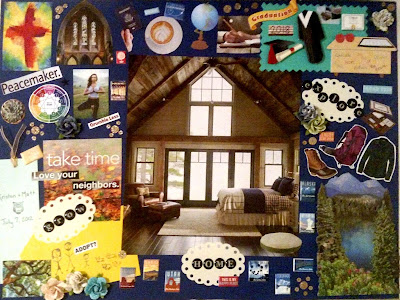
When I reflected on what components I need to be happy in the future, to be secure, the answers came easily. I need a steady spiritual practice and I want to grow in my convictions and right actions in that arena. I want to live in a landscape I love. I need to see the sky. I need elevation changes on the horizon. I need to see mountains, and I'd love to be in the mountains, because I want to spend more time outdoors, but I am a picky bitch about which outdoors landscapes I enjoy. I don't like flat land and I do not care about beaches. I want a home. A place that is our own, with a small yard for the dogs, and space to host visitors. And I need to be closer to my friends and family. Matt and I have set a goal of no more than 15 hours of driving time away from Gilbert, so that we can put all the animals in the car and get home in one day of driving. And as far as the job goes? I'd like to still teach or work directly with students. The only thing that I need out of a job is the feeling that I am impacting someone or something. That my skills are helping someone directly. That's why I like teaching. So, I'll apply for some college teaching jobs, some secondary teaching jobs, and some college advising positions, and I want to learn more about Children's Librarian programming positions. If I don't get the fanciest jobs, that is totally FINE because what I've realized is that what I do to pay the rent and get health insurance matters so little to me in the scope of things.
These are not things I knew or thought I needed when I chose to leave Arizona for a PhD program in Florida. I was going to be the career woman who didn't marry until my late 30s, if at all, who moved across the country in pursuit of ambitious career goals. Of course, Matt came along way too early for my plans, so I accepted that I would be a young married person, but I still thought career goals topped everything else for me. And now, thanks to four years of breakdowns, and yoga, and meditation, and general navel gazing, I know that what I need is to just live somewhere I love, somewhere I can go outside and enjoy nature, somewhere with good local food and closer to our friends and family. I am motivated to finish the degree, not for the career opportunities it will bring, but because it means we are free to move on and find the right place for us.
Being in a PhD program was so much harder and stranger than I ever could have imagined, but it turned out to be the perfect reason to sort out my priorities, and for that I am grateful.
"I use the Pensieve. One simply siphons the excess thoughts from one's mind, pours them into the basin, and examines them at one's leisure. It becomes easier to spot patterns and links, you understand, when they are in this form." ~Albus Dumbledore, Harry Potter and the Goblet of Fire
Wednesday, June 28, 2017
Saturday, June 17, 2017
Dear (Fellow) White People
The first time my Facebook posts started drawing rebuke from certain friends and family members was when I posted in defense of Black Lives Matter. One racist acquaintance took to commenting in ill-formed and misspelled sentences about how Black people were thugs, and when I deleted his comments, he took it as an invite to start private messaging me Infowars and Breitbart articles about how Black people are thugs, and didn't I know that BLM was a terrorist organization that wants all white people dead? They're not and they don't, and that person has since been deleted and blocked. I got into a political argument with a family member about the death of Freddie Gray. Can't they agree that, regardless of a person's race or even crimes committed, they don't deserve to have their spinal cord severed in the car ride to the police station? Before Trump's campaign, BLM was the topic that opened my eyes to the disconnect between my world view and the world views of people I know and love. But what is to be done about it?
Sometimes, like when that person used to be married into your extended family and isn't any more and private messaging you offensive and violent garbage, they can be deleted. Sometimes, you love this person and have an otherwise close relationship with them so you drop it to save the relationship. But, you can't let it go permanently. I can't let it go because lives are on the line.
Two years ago, 9 Black church members were studying their Bibles on a Wednesday night in their sanctuary, their safe place, and a white supremacist murdered them, a white supremacist radicalized by the same alt-right conspiracies and hate speech that have found an elevated platform under this administration. This white supremacist took the lives on nine people, without guilt, because he believed the hateful ideologies maintained by Breitbart, and InfoWars, and the other insane rags racists like to message me articles from. White supremacy means that Black Americans are not safe in their own houses of worship. These ideologies have consequences.
Yesterday, the courts ruled again that cops can kill Black people without legal consequences. Philando Castile was pulled over in a traffic stop because the officer thought he "looked like someone involved in a robbery" even though he couldn't get a good look at the passengers... Castile then informed the police officer that he had a gun on him because he had a concealed carry permit before reaching for his ID in his wallet. The officer shot him SEVEN times, killing him, with his fiancee in the passenger seat filming the whole exchange, and his young daughter in the backseat, watching her father get murdered. Yesterday, the jury found him not guilty, not even on charges of murder, but on charges of second-degree manslaughter and reckless discharge of a firearm. Does it matter that Castile was following the directions of the officer and had a permit to carry? No. Because the officer's fear of a Black man with a gun justifies that man being shot seven times inside his own vehicle in front of his child. Does it matter that Castile was not a robber, but a beloved public schools worker whose death inspired the school children to send him letters with hand-drawn rainbows expressing how big his heart was and how sad they are that he is gone? No. Because his Blackness overrode the goodness, the love he poured into this world. This case shows once again that racist fear matters more than Black lives, and living good lives won't keep Black people alive.
Today is just another day in America with yet another reminder that our racism has deadly consequences. So today I'm praying for a day when we can agree that Black Lives Matter, regardless of political party affiliations, and I'm donating to organizations that support black communities and advocate for police reform. I'm also promising that I will continue to have tough conversations with my people, because we cannot allow this hate to flourish in our own families, our own communities. It's just too dangerous. We have to do better, for Philando Castile and for Reverend Clementa Pinckney, Cynthia Hurd, Reverend Sharonda Coleman-Singleton, Tywanza Sanders, Ethel Lance, Susie Jackson, Depayne Middleton Doctor, Reverend Daniel Simmons, and Myra Thompson.
| Philando Castile |
Wednesday, June 14, 2017
Spiritual Strategies for Resistance; Or, How I'm Tricking Myself into Being Less of an Asshole
I can walk the other way to avoid seeing the offending cars in my neighborhood, but I cannot avoid seeing them in the parking lot at Target or driving in front of me on campus. This is central Florida after all. Walking the other way is really not a solution. So, I started doing a small thing every time I see a bumper sticker that would usually send me into a rage spiral: I started praying for its owner. When I am walking the dogs, and I see that TRUMP car, I mutter under my breath "Lord soften their hearts." When I am walking the dogs alone, this is fine and good. But, yesterday, I was walking to the campus parking garage with Matt and I saw a Hillary Liar Liar bumper sticker paired with a Trump sticker (oh the irony!), and, in the middle of my sentence, I said "Lord soften their hearts" and shook it off. This caused some confusion because I had been talking to Matt about how predatory academic publishing can be, and he thought I was talking about Academic publishers, and I guess that works too. Then, later last night, I saw a car covered in roughly 50 bumper stickers with everything from hate speech towards Obama and Hillary to slurs against all Liberals. You know the car. We've all seen this car. The "Lord soften their hearts" wasn't doing the trick so I just kept going: "Lord, soften their hearts, quicken their minds, improve their knowledge!" So, is this strategy a little pointed and self righteous? Oh yeah. Does it help to remind me of the humanity behind the bumper sticker? A little. Does it help me shift my rage response into something different, focusing my energies on my desire for more intelligence and kindness in the world? Yes. And, if I'm lucky, maybe it will keep me from any car accidents caused by rage black outs.
Because I am naturally a bit of an asshole, a bitch, etc., this small act is about all I can manage on my own, so I listened to a Liturgists podcast I've been meaning to listen to in which they interview Christina Cleveland about spiritual strategies for healing and advocacy. Cleveland is a professor of reconciliation theology at Duke Divinity, and the Liturgists hosted a conversation with her post-election but pre-inauguration about how those that felt broken, dismayed, and bitter about the election could more forward. If you have a little over an hour and this is a topic that interests you, then I suggest you listen to it, because it was an amazing conversation. But, if not, I'll boil down some of the tips that I found so useful.
Cleveland, like me and so many of my colleagues, had to teach the morning after the election, and she entered a classroom of depressed, shocked, and terrified students that needed healing. These are the steps she led her students through, and the ones she recommends for all of us trying to cope with the grief and resentment and get to a better place: She began the class by allowing them to lament; they shared their collective grief, anger, and fears for the future. Then, she asked them to reflect on what God means to them and the goodness they still see in this world. Then, she borrowed a technique from AA practices called the Resentment Prayer. She asked her students to create a list of things that they want to pray for for themselves--good health, better relationships with loved ones, freedom from fear, etc.--then, after they had compiled their lists, she told them that they would be praying those things for Trump instead. She said, we are going to force ourselves to pray for this goodness in his life. After they were done with that, they did the same thing for Trump voters. Wow.
I don't know about you, but I was nowhere close to having any impulse to pray for Trump or those who voted for him on Nov. 9th. I still have a hard time praying for Trump. I'm convinced her students had the advantage over me because they didn't know what she was going to make them do. I know, so it's very easy for me to say that my "Resentment Prayer" for Trump is that he become more honest, mentally stable, and aware of the hate in his heart. While some of these things might be what I would also pray for for myself, I can obviously skew the list if I know I am going to make myself pray for Trump instead. Plus, I'll admit I do not want to pray for his health. Now, I do not exactly pray against his health, but I do feel small amounts of hope when I read about his atrocious dietary habits and distrust of exercise--like maybe nature will take its course. It's horrible, I know, and I wish I didn't feel this way, but I do. It is much easier for me to do this prayer technique with his supporters, and it has been so helpful in forcing me to recognize the humanity, the god-given potential (to borrow a phrase from Hillz), of even those I deeply disagree with. And someday I'm hoping to get to a point where I can pray for Trump's good health and mean it.
Another strategy that they discussed is making a list of the ways in which the Trump voters you know still do good in this world. One of the hosts said that it helps him to realize that the main difference between him and Trump voters is just his level of awareness and acknowledgement of these social issues. He (as a white man) is equally as complicit in the white supremacy that enabled Trump and many of his voters, but he, unlike them, recognizes it for the evil that it is. At the end of the day, many of their actions (good and evil) are pretty comparable. I've also found it super helpful to distinguish between policies and action when I am trying to overcome my resentment of the other side. One of the main recipients of my resentment and judgment is Conservative Christianity. I find so many of the beliefs of these churches abhorrent and offensive, and I blame them for allowing millions to think that somehow supporting the hateful treatment of the poor, the immigrant, the outcast can be a Christian stance. So, when I do this exercise, I list the good they do in this world regardless of their ideologies I find so toxic. For example, most conservative megachurches are heavily involved with food pantries and kitchens. They fund and volunteer at shelters, and lately they have become more involved in foster care and adoption. These are all causes I believe in too. It helps me to overcome my reactionary rage if I remind myself of the good these institutions are doing in this world, and how they can afford to help some of these situations in ways that I, and the smaller churches I attend, cannot. I then do this on a smaller level. For instance, one of the things I admire about X Trump voter who I am trying to soften my heart towards is that they easily maintain a friendly and welcoming stance towards strangers. They will give someone in need a ride, they will stop to say hello, they build relationships with their employees. I, on the other hand, avoid eye contact with as many humans as possible. So, in this way, X Trump voter lives out their Christianity more authentically than me since I find it so hard to make my physical actions reflect the welcoming ideals I firmly believe in. It has helped me immensely to remember the ways in which I fail to live up to all of my values. It undercuts my tendency towards self-righteousness and indignation and reminds me to be humble in my assessment of others.
So, these are just some of the things that I do to try to trick myself into being less of an asshole. I pray for the hearts of the owners of offensive bumper stickers. I pray for all of the blessings that I would want for myself and my loved ones to fall on those I resent, and one day I hope to be able to do that with Trump. And I make lists--who doesn't love some good list making?--of the ways in which I fail to live by my values and the ways in which those I've been judging do embody some of those same values. I have no expectations that any of these practices will actually change the hearts and minds of those I oppose. My desire is that it will help soften my own heart and allow me to assume a more peaceful and contemplative stance towards others. I don't want to let the bastards grind me down, or lessen my humanity, or zap my emotional energies. And, the most optimistic part of me--which is a very tiny, minuscule piece--hopes that someone on the other side is doing the same thing.
Tuesday, June 6, 2017
On the Inconvenience of Other People; or Why, Despite All of the Meditation, Yoga, and Prayers, I'm Still A Bitch
I would like to blame other people. It is much easier for me to love my neighbor by donating to causes that help the least among us, the refugees, the poor, the victims of hate crimes and oppression, than it is for me to be kind to my literal neighbor. After all, they slam the kitchen cabinets when they cook, they park like idiots who have never seen a straight line, and they complain that you are moving furniture late at night when you are most definitely on the couch watching Netflix. For me, a good relationship with a neighbor is one in which we both avert our eyes and pretend not to notice each other when we pass each other in the stairwell. I detest small talk, so I avoid my neighbors when I can, and some of my neighbors downright annoy me. It's so simple to love my neighbor in Syria through donations or letter writing, but it seems nearly impossible for me to show love to my literal next-door neighbor.
But what about non-neighbors? I pretty much struggle to show kindness and empathy to most people I interact with on a regular basis. For example, I avoid any sort of socializing or mingling with my colleagues if I can help it. The annual department party is something I used to force myself to go to (all the while being annoyed and desperately wishing to escape); it is now something I gleefully ditch. Most of the people I've worked with probably think I am a bitch, and they are not wrong because I can be bitchy. It's actually my first response to social situations. Since I came to Florida, alone, I've gossiped about colleagues behind their backs, I've scoffed at their struggles, and I've celebrated their failures. I've been actively kind to maybe ten of my colleagues in my 4 years here. I'm telling you, I am a bitch, and the yoga hasn't cured me.
Then there's the (few) people I actually let in. I do not make friends easily, and I do not keep many of them. My closest friends are from high school, and I still keep in touch with that small group. I made a handful of friends in undergrad, mostly Matt's friends and my sister's boyfriend. I made 3 friends in my master's program, and they were the people I shared an office with. And, in Florida, I've made a few friends. Even with my friends, I can be a bitch. I tend to tune out when they are struggling with something and need to talk it through, or I am too forceful with my opinion of what they should do, and I've always had a problem with talking about the person who's not in the room at the moment. I do think that I have improved since my younger days. In high school and undergrad, my friends grew resentful of my exacting judgment. I could be cruel to them when they did something I did not agree with. I was often not a good friend, and I have worked to change that. However, I still wish that I could be a more loyal friend, that my first response to a friend's pain would be compassion and not "this is how you should fix it," that I could get over my tendency to engage in petty gossip even about my own friends. I need to be kinder in my friendships too.
Finally, there's family. If I wanted to go into detail about how my bitchiness affects my ability to be a good sister to my siblings, I would need another blog post. Let's just say my exacting judgment and cruel responses to someone acting in a way I wouldn't have always plagued my relationships with my siblings. I'm sure its the subject of several of their diary entries and rants to friends. This is something I've worked on changing, and I think I've made progress. However, I do still struggle to forgive family members for doing something I disagree with, especially when it comes to Trump. While I have been the subject of some familial ugliness this past year, my immediate family has stood by me and defended me, and for that I am grateful; however, someone in my immediate family voted for Trump, and I have struggled to get over that. It feels personal. It feels like a rejection of me and the many well-reasoned (or so I thought) calls for logic and compassion I posted throughout the election year. I've struggled to show grace to those I love who voted for that man. I've struggled to forgive them. I've struggled to understand their point of view.
On some level, I recognize that my own coldness in social interactions, my tendency to gossip and mock, my obvious annoyance and disgust with other people, detracts from my credibility when I am calling for kindness, compassion, and empathy. Why should someone listen to me when I am arguing for a truer, more compassionate Christianity but I fail to show compassion to my friends, family, neighbors, and coworkers? I truly believe all of these things, and yet, I so struggle to put my beliefs into action when it comes to people I have to interact with. People I've never met do not disappoint or frustrate me, and so it is so much easier to show them love and kindness. It is much more difficult to practice kindness to the person who voted for Trump, who parks in your spot, or who posts too many obnoxious hipster photos to Instagram.
By now it's probably become obvious that I do not really think the problem is other people. We are all human. They are doing their best to get by. They are grappling with the same world filled with hatred and violence and darkness that I am. Most days I think that the problem is me. After all, I meditate! I read! I pray! I recite mantras! I practice yoga and yet I remain inflexible (both physically and mentally). At times I think that these contemplative practices are just at odds with who I am. I'm just not a hippie-dippy, share-the-love sort of person, right? But, then again, some of these practices have to resonate with me if I choose to return to them day after day. So, maybe my bitchiness, my tendency to respond to others with rejection, cruelty, or self-defensive withdrawal, is not who I am. It's just who I have been, and Who I Am Hates Who I've Been (that's a little Relient K reference for you). Or maybe both of these things are true. Richard Rohr would say that viewing this as one of two options reflects that I am trapped in the Dualistic Mind. It's not either/or; it's both/and. Humans are complicated, and yes, annoying, and that includes me. I am a meditating, yoga-doing, mantra-reciting hippie, and I am a judgmental bitch. I am both, and maybe accepting that both of these sides of me can coexist will allow me to acknowledge my bitchy impulses and still choose kindness and empathy. People will continue to do annoying things, and my bitchy self will continue to be annoyed by them. People will continue to piss me off and disappoint me and drive me crazy. However, my hippie self knows that I can acknowledge my emotional responses as valid but still choose kindness and empathy. It's not a failing on my part that I am annoyed by other people, but it is a failing when I allow that annoyance to prevent me from treating others well. So, that's where I've arrived on the issue. How hippie-dippy do I sound? ☮
Tuesday, May 23, 2017
Not My President (?)
On any given day since November 8th, I am not sure which emotion is going to beat out all of the others for top position. Outrage, anger, depression, and terror have all been top contenders, but today I mostly feel embarrassed.
The president of the United States commented that he had just left the Middle East while he was in Israel. His official statement on the Manchester terrorism event called the attackers "evil losers," and his note at Yad Vashem, a Holocaust memorial in Israel, read like the note of a school field tripper who was just glad to have an excuse to ditch class: "It's so great to be here with all of my friends. So amazing!" At best, everything this man says and does sounds like an adolescent schoolyard bully, but he's not a child. He is just too intellectually lazy and emotionally incurious to care about anything but his own popularity and power. It embarrasses me. I am ashamed that this man leads my country and I worry about what the rest of the world now things about us. How could anyone elect this man to lead a nation?
But here's the thing: I didn't vote for him. He's "not my president," right? Why am I so embarrassed? It's not like he represents me or my values. I did everything I could to prevent his election. Why am I wracked with embarrassment while his supporters are incapable of being shamed by his actions?
I think part of the answer to these questions is that, though he does not represent my values or my beliefs, I come from the community that widely endorse this man. I am white and Christian. Growing up, I never heard the terms "evangelical" or "mainline." I was just a Christian. I had no familiarity with denominations or with these labels, but I grew up in non-denominational churches that were non-affirming of queer people, that denied any scriptural authority to women, and denied the possibility of evolution. The churches I attended did not always scream their conservatism from the roof tops. In fact I only realized some of their stances from noticing what was taught and not taught, how certain scriptural passages were interpreted, who was allowed to speak on Sunday mornings. In the current political climate, these stances have become more boldly stated. I was recently Facebook stalking a former pastor and I found out he is now involved with what I would label a truly nutjob church. Their statement of faith denies the validity of psychology and counseling, labeling it anti-biblical because it robs God of his authority. Really. When I think about the damage that that position could cause, especially when you consider that the church is non-affirming of queer existence. Queer Christians have the highest suicide rate in the nation and you want to deny them the counseling that could be life saving? It disgusts me. And I was a bit horrified that this man used to deliver sermons to me every Sunday. What other sorts of dangerous ideologies did he have that I never knew about? When I look at all of this, I understand how people in these churches could be convinced to vote for Trump in droves.
Now, I do not want to sound ungrateful for my childhood and adolescent churches. I wouldn't trade away my summers at church camps or the personal faith that often sustained me in adolescence. I still find solace in many of the worship songs I sang in these churches. My siblings and I were all raised in this brand of Christianity, and we all became empathetic, balanced, and open-minded adults. There were also some things that I would change if I could--the sexist and damaging purity rhetoric that only targeted girls, and the youth group meeting where the pastor told us that a nuclear bomb had been launched towards us so that we would get right with God (really), for starters. While I can name the blessings of this faith tradition, I left this brand of Christianity several years ago.
The Christ in my gospels in on the margins. He stands by the vulnerable and he is not interested in rejecting outsiders from his presence. My Christianity is about recognizing the image of God in all of humanity, it's about defending human dignity. My Christianity is about realizing that we are all one, and anything that harms one individual is anti-Christ. This includes homophobia, racism, sexism, war, terrorism, hate crimes, etc. etc. etc. And while there are some evangelical churches that practice this type of Christianity, I have found this expression of faith in the Episcopal church.
So, I am a former Conservative Christian and because of this Trump is my president. The church that elected Donald Trump is in my blood, and perhaps that is why I feel a bit complicit and embarrassed. I also feel complicit (and complicit by the dictionary definition, not the Ivanka definition) because I failed to reach my people over 2016. My Facebook friends can all attest that my 2016 posts were largely addressed to White Christians. I spent the year desperately trying to appeal to our common faith. I was convinced that they could see that Christ's message was one of radical inclusion, that the gospel truth is that we should welcome the stranger, that all humans carry the image of God and so of course black lives matter. But I couldn't even convince people in my immediate family of this. I failed, and I suspect that I failed because I struggle to "speak the truth in love" instead of screaming the truth in outrage and frustration, and so I accept some responsibility for Trump's election.
Finally, when I started this blog I said I was going to address my tendencies to be an asshole. You perhaps noticed that my tone is a bit more vitriolic than my progressive profession of faith might suggest. Here, I say that when I look at the gospels I see a Christ that is interested in radical inclusion and yet, I love to say that what Trump supporters believes is not Christian. I say Christ includes everyone, but I still groan when my church prays for POTUS in our Prayers of the People every Sunday. And I would grimace if someone showed up to church in a MAGA hat. So, I am working on it. His supporters may support things that I see as purely anti-Christian, but they are still Christian. I do not know their relationship with Christ and I do not know the mind of God. Even though the Episcopal Church is more liberal than most, I am sure that when I take communion every Sunday I am at the table with Trump voters, which means we are one in Christ. And I am working on accepting that. I'll close with a passage from a prayer from St. Augustine's Prayer Book that I have to pray quite frequently since the election:
Amen.
The president of the United States commented that he had just left the Middle East while he was in Israel. His official statement on the Manchester terrorism event called the attackers "evil losers," and his note at Yad Vashem, a Holocaust memorial in Israel, read like the note of a school field tripper who was just glad to have an excuse to ditch class: "It's so great to be here with all of my friends. So amazing!" At best, everything this man says and does sounds like an adolescent schoolyard bully, but he's not a child. He is just too intellectually lazy and emotionally incurious to care about anything but his own popularity and power. It embarrasses me. I am ashamed that this man leads my country and I worry about what the rest of the world now things about us. How could anyone elect this man to lead a nation?
But here's the thing: I didn't vote for him. He's "not my president," right? Why am I so embarrassed? It's not like he represents me or my values. I did everything I could to prevent his election. Why am I wracked with embarrassment while his supporters are incapable of being shamed by his actions?
I think part of the answer to these questions is that, though he does not represent my values or my beliefs, I come from the community that widely endorse this man. I am white and Christian. Growing up, I never heard the terms "evangelical" or "mainline." I was just a Christian. I had no familiarity with denominations or with these labels, but I grew up in non-denominational churches that were non-affirming of queer people, that denied any scriptural authority to women, and denied the possibility of evolution. The churches I attended did not always scream their conservatism from the roof tops. In fact I only realized some of their stances from noticing what was taught and not taught, how certain scriptural passages were interpreted, who was allowed to speak on Sunday mornings. In the current political climate, these stances have become more boldly stated. I was recently Facebook stalking a former pastor and I found out he is now involved with what I would label a truly nutjob church. Their statement of faith denies the validity of psychology and counseling, labeling it anti-biblical because it robs God of his authority. Really. When I think about the damage that that position could cause, especially when you consider that the church is non-affirming of queer existence. Queer Christians have the highest suicide rate in the nation and you want to deny them the counseling that could be life saving? It disgusts me. And I was a bit horrified that this man used to deliver sermons to me every Sunday. What other sorts of dangerous ideologies did he have that I never knew about? When I look at all of this, I understand how people in these churches could be convinced to vote for Trump in droves.
Now, I do not want to sound ungrateful for my childhood and adolescent churches. I wouldn't trade away my summers at church camps or the personal faith that often sustained me in adolescence. I still find solace in many of the worship songs I sang in these churches. My siblings and I were all raised in this brand of Christianity, and we all became empathetic, balanced, and open-minded adults. There were also some things that I would change if I could--the sexist and damaging purity rhetoric that only targeted girls, and the youth group meeting where the pastor told us that a nuclear bomb had been launched towards us so that we would get right with God (really), for starters. While I can name the blessings of this faith tradition, I left this brand of Christianity several years ago.
The Christ in my gospels in on the margins. He stands by the vulnerable and he is not interested in rejecting outsiders from his presence. My Christianity is about recognizing the image of God in all of humanity, it's about defending human dignity. My Christianity is about realizing that we are all one, and anything that harms one individual is anti-Christ. This includes homophobia, racism, sexism, war, terrorism, hate crimes, etc. etc. etc. And while there are some evangelical churches that practice this type of Christianity, I have found this expression of faith in the Episcopal church.
So, I am a former Conservative Christian and because of this Trump is my president. The church that elected Donald Trump is in my blood, and perhaps that is why I feel a bit complicit and embarrassed. I also feel complicit (and complicit by the dictionary definition, not the Ivanka definition) because I failed to reach my people over 2016. My Facebook friends can all attest that my 2016 posts were largely addressed to White Christians. I spent the year desperately trying to appeal to our common faith. I was convinced that they could see that Christ's message was one of radical inclusion, that the gospel truth is that we should welcome the stranger, that all humans carry the image of God and so of course black lives matter. But I couldn't even convince people in my immediate family of this. I failed, and I suspect that I failed because I struggle to "speak the truth in love" instead of screaming the truth in outrage and frustration, and so I accept some responsibility for Trump's election.
Finally, when I started this blog I said I was going to address my tendencies to be an asshole. You perhaps noticed that my tone is a bit more vitriolic than my progressive profession of faith might suggest. Here, I say that when I look at the gospels I see a Christ that is interested in radical inclusion and yet, I love to say that what Trump supporters believes is not Christian. I say Christ includes everyone, but I still groan when my church prays for POTUS in our Prayers of the People every Sunday. And I would grimace if someone showed up to church in a MAGA hat. So, I am working on it. His supporters may support things that I see as purely anti-Christian, but they are still Christian. I do not know their relationship with Christ and I do not know the mind of God. Even though the Episcopal Church is more liberal than most, I am sure that when I take communion every Sunday I am at the table with Trump voters, which means we are one in Christ. And I am working on accepting that. I'll close with a passage from a prayer from St. Augustine's Prayer Book that I have to pray quite frequently since the election:
Grant, O Lord, that I may remember your rule and follow your example by loving my enemies and by speaking the truth in patience and love. Give me courage to work for what is right and just in all of my dealings. Temper any righteous indignation with patience and humility and keep me from any collusion with injustice.
Amen.
Sunday, May 7, 2017
Start a Blog, They Said
2016 has brought a lot of ugliness to the forefront of America's consciousness. Half of the country watched in horror as the other half elected a man who seems to represent the worst of this country: nativism, racism, sexism, xenophobia, homophobia, ableism, etc. etc. etc.; name a prejudice and we bleeding hearts can point to the ways in which Trump has bolstered it. Among those of us who watched in horror and disbelief were those who were watching the culture they were raised in pledge allegiance to this man and the hate he represents. I'm speaking specifically as someone raised in the White Conservative Christian culture. So, for me, it felt personal. The same people who ingrained WWJD in my adolescent brain lined up to endorse a man who represents so much that Jesus opposed: assault and disrespect of women, robbing of the poor, unapologetic dishonesty, etc, etc, etc. I was perplexed, heartbroken, betrayed, and angry for much of 2016, and all of that has remained with me since his election. All of this heartbreak and anger manifested in several ways in my life. I remain depressed and every day feels like waking up in a hell dimension. I now invest a lot of my time into following international politics that I would not have cared about one year ago (CONGRATS to the French for rejecting their own racist psychopath). And I now suffer from a tendency to get on my soapbox on Facebook. It is that last development that has led to this blog.
While my Facebook rants and ramblings have been welcomed by some on my feed, they have resulted in a fair amount of blocking and nastiness from some in my family. And that's fine, really. Throughout it all, I've had several people tell me I should start a blog. Some of them suggested this as an underhanded way to get me to STFU on Facebook. If I start a blog, offended parties can just choose to not click into the posts rather than having to be reminded that I find their behavior and their candidate deplorable on a regular basis. This blog isn't for them. Some suggested it in a genuine way, implying that they appreciate my voice and maybe my stark, and I guess this blog is a little bit for them. However, most of all I guess this blog is for me. If my Facebook rants are any indication, I have a lot of processing to do, so why not channel it into a blog?
Once I decided to give in to the suggestions that I start a blog, the first difficulty was what it should focus on. There are enough people on the internet sharing their moral outrage so I did not want it to be necessarily a political blog. Plus, I fear having to deal with the Pepes and trolls in the comments section if my blog found its way into the deplorable circles of internet hell. For me, the biggest struggle with all of this has been that my journey from Republican teenager to Bleeding-Heart adult (maybe I'll share more on that later) has largely been caused by development in my empathy. I know in my bones that Trump is despicable and vile because I now empathize with communities that I never thought about when I was more conservative. In part, this is due to my Liberal Arts education and in part it is due to listening to new voices (in the classroom, on Twitter, through literature, etc.). My bleeding-heart sensibilities have also been strengthened by my journey towards a more progressive Christianity, following the lead of my spiritual gurus, Anne Lamott, Diana Butler Bass, Rachel Held Evans, and Nadia Bolz-Weber, among others. And therein lies the rub. If I claim that empathy is what led me to become more liberal, then how can I hate Trump and his voters with a sometimes-all-consuming passion? (And I do). How do I resist the assholes without lapsing into asshole-dom myself?
So, I titled this blog "Confessions of a Recovering Asshole" because I recognize the tendency in myself to be an asshole. When I see loads of rich white men celebrating stripping healthcare away from millions, I think Ugh! Have some empathy you shitheads!, and then I wish pre-existing conditions on those men. When I see a Trump/Pence bumper sticker, hatred boils in my stomach and I think What trash! See the problem with that? Now I'm not saying that everyone should feel guilty for wishing suffering on the men who are bankrupting our nation to line their pockets; I am just saying I do, because it is out of step with my own journey. So, I'm here to call out my own asshole moments, work on keeping my empathy even while I watch those in power dismantle good programs and endanger people I care about, and maybe just maybe escape the perpetual outrage culture I find myself enmeshed in. Because I do not want to contribute to the ugliness that is boiling over in this country. I want to try to speak from love and I desperately want to come out of all of this without a hatred of humanity, and neither of those are easy things right now. So, join me, or don't. I may post frequently, or I may not. My blog may be helpful or entertaining to any readers that stumble across it, but I'm perfectly fine if the only person it helps is me.
While my Facebook rants and ramblings have been welcomed by some on my feed, they have resulted in a fair amount of blocking and nastiness from some in my family. And that's fine, really. Throughout it all, I've had several people tell me I should start a blog. Some of them suggested this as an underhanded way to get me to STFU on Facebook. If I start a blog, offended parties can just choose to not click into the posts rather than having to be reminded that I find their behavior and their candidate deplorable on a regular basis. This blog isn't for them. Some suggested it in a genuine way, implying that they appreciate my voice and maybe my stark, and I guess this blog is a little bit for them. However, most of all I guess this blog is for me. If my Facebook rants are any indication, I have a lot of processing to do, so why not channel it into a blog?
Once I decided to give in to the suggestions that I start a blog, the first difficulty was what it should focus on. There are enough people on the internet sharing their moral outrage so I did not want it to be necessarily a political blog. Plus, I fear having to deal with the Pepes and trolls in the comments section if my blog found its way into the deplorable circles of internet hell. For me, the biggest struggle with all of this has been that my journey from Republican teenager to Bleeding-Heart adult (maybe I'll share more on that later) has largely been caused by development in my empathy. I know in my bones that Trump is despicable and vile because I now empathize with communities that I never thought about when I was more conservative. In part, this is due to my Liberal Arts education and in part it is due to listening to new voices (in the classroom, on Twitter, through literature, etc.). My bleeding-heart sensibilities have also been strengthened by my journey towards a more progressive Christianity, following the lead of my spiritual gurus, Anne Lamott, Diana Butler Bass, Rachel Held Evans, and Nadia Bolz-Weber, among others. And therein lies the rub. If I claim that empathy is what led me to become more liberal, then how can I hate Trump and his voters with a sometimes-all-consuming passion? (And I do). How do I resist the assholes without lapsing into asshole-dom myself?
So, I titled this blog "Confessions of a Recovering Asshole" because I recognize the tendency in myself to be an asshole. When I see loads of rich white men celebrating stripping healthcare away from millions, I think Ugh! Have some empathy you shitheads!, and then I wish pre-existing conditions on those men. When I see a Trump/Pence bumper sticker, hatred boils in my stomach and I think What trash! See the problem with that? Now I'm not saying that everyone should feel guilty for wishing suffering on the men who are bankrupting our nation to line their pockets; I am just saying I do, because it is out of step with my own journey. So, I'm here to call out my own asshole moments, work on keeping my empathy even while I watch those in power dismantle good programs and endanger people I care about, and maybe just maybe escape the perpetual outrage culture I find myself enmeshed in. Because I do not want to contribute to the ugliness that is boiling over in this country. I want to try to speak from love and I desperately want to come out of all of this without a hatred of humanity, and neither of those are easy things right now. So, join me, or don't. I may post frequently, or I may not. My blog may be helpful or entertaining to any readers that stumble across it, but I'm perfectly fine if the only person it helps is me.
Monday, February 24, 2014
On Being Dissatisfied with Dark Television
Let me start off this post by saying that this last year or so has been a dark tv-viewing year for me. Between last year and this year, I've watched all of Sons of Anarchy and Dexter, AHS: Coven, House of Cards, The Walking Dead, and, most recently, True Detective and House of Cards season two, and I am getting really tired of all the bull shit, so tired, in fact, that I would rather watch reruns of Gilmore Girls and 30 Rock than watch new episodes of True Detective or House of Cards, and here is why:
It seems like all of these "serious" shows that are met with such positive critical acclaim are all about how much shocking violence and human suffering they can pack into a 50-minute episode. These shows are filled with rapes, graphic murders ranging from dismemberment to shoving girls in front of trains, torture of animals and people, and any other means of making the characters miserable and the viewers uncomfortable. At one point in this season of House of Cards I had to leave the room so I could not hear the squealing of a guinea pig about to be crushed underfoot. It has gotten so bad in all of these shows that Matt and I have begun to identify which characters--human and animal--are introduced solely so they can be brutally tortured or murdered on camera later in the season.
Now, I am not necessarily prudish about violence. I understand that rape is a reality and that people lie, cheat, murder, and rape every day. My issue with these shows is that it has reached the point where that is all these shows are doing. In Slate's defense of the misogyny in True Detective (which is blatant and atrocious), the author concludes that it is okay because the message of the show is that men do bad things. No shit. Men do bad things? Men do bad things sums up the messages of Sons of Anarchy, The Walking Dead, and House of Cards. Imagine that. AHS:Coven would like to add that women do bad things, too. Yes, I get it. It's true. People suck. Nihilism is cool. But I am looking for something with more substance.
I am also suspicious of this message. We have a million shows telling us that people suck, we are all depraved, the world is shitty, and there is nothing we can do about it. That message seems to me to be a cop out. It invites us to ignore social realities. It allows the privileged viewers of the show to get desensitized to violence and human suffering, and it ignores the fact that there are real problems in this world that can be helped by human action. It glosses over the fact that much of the suffering in this world occurs as a result of racism, sexism, and wealth disparity. And the fact that most of these shows are about white men and their problems only strengthens my suspicions.
So, I am sick of this trend in television. I want something with character development, something in which female characters exist as something more than plot devices, something with a real message, something that doesn't leave me feeling both violated and implicit when I finish an episode. Sadly, some of these shows began with promise. I think American Horror Story's first two seasons are great and I much prefer them to this last season in which each new episode depicts women finding a new way to torture each other. I am probably most upset by the demise of Sons of Anarchy, which I thought was going somewhere in the first few seasons, but the last season made it clear that the show is only about violence and suffering and the female characters that I became so invested in are simply there to facilitate more gratuitous violence and human suffering.
That being said, I am looking to season two of The Americans to restore my faith in television and provide me with the smart show with substance that I am looking for. Until then, I will continue to rewatch Gilmore Girls, Buffy, and 30 Rock.
I owe this post to Netflix; without it I never would have been able to binge watch all these shows and reach the dark, frustrating place that led me to write this.
Tuesday, August 27, 2013
The Awesome Bitch on Television
Recently, I have been on a Jezebel kick, which is probably better than my Sons of Anarchy binge. During my perusal of their publications yesterday, I found "Breaking Bitch: Admit You Have a Problem with Women." In this article, the author grapples with Anna Gunn's claims in her New York Times piece, "I Have a Character Issue." Basically, Anna Gunn argues that the mass hatred of her character, Skyler White on Breaking Bad, is gendered. She explains that most of the problems with her character come from the misguided notion that a woman should "stand by her man" even when her man is a homicidal meth-cooking psychopath (my words, not hers). I immediately felt vindicated, because I have had quite a few debates about this with my husband. They go something like this:
"Skyler is such a bitch."
"Why?"
"She's just awful, and she's always undermining Walt or getting angry for no reason."
"You mean she undermines her husband who is putting her family in constant danger by cooking meth, and gets angry at him for violating federal law and risking his own life? That sounds unreasonable."
While I don't have a good leg to stand on because I have never seen more than a few episodes of Breaking Bad, the same misogynistic phenomenon affects Betty Draper. Betty is constantly criticized for being a dumb bitch because she cheats on Don or because she is, yes, bitchy to the man who repeatedly cheated on her for their entire marriage. Does Betty have problems? Yes. Are Don's problems worse? Yes. Who is hated more? Betty. And I think that is ridiculous. However, while my defense of Skyler and Betty makes me feel like a good little feminist, I am guilty of the same treatment of Lori on Walking Dead.
Oh my goodness, do I hate Lori. Not only do I hate her, but I actually was rooting for her gruesome death. And while, like the author of "Breaking Bitch," I do feel justified in saying that she is an awful character, I also cannot honestly say that my gendered expectations did not play a role in my hatred. She was an unfaithful wife, she was a negligent mother, she made Rick kill his best friend! But, Rick is no more attentive to Carl than she is, and Shane is as much to blame for the affair and his own murder as she is, and I do not feel the same guttural hatred for them that I feel for Lori. The same goes for Cersei Lannister (boo! hiss). Every time I read a Game of Thrones book, I have this internal debate: should I like Cersei? Stand behind her as a strong woman who thwarts patriarchal power? But at the end of the day, I can't. I mean, she's the worst, right? But is she any worse than Jaime, who I sometimes find myself crushing on? How is it that when a woman is maniacal, deceptive, conniving, she is an evil bitch, but when a man is the same thing, he is a sexy genius?
Needless to say, this idea has been percolating in my head for a day now, and it has fueled many conversations between me and Matt. We both come to the same conclusion that our hatred of certain female characters stems from differentiated expectations of what makes a good male character and what makes a good female character. The issue is that the flawed, immoral, but somehow redeemable male hero is a staple of literature; he is the Byronic hero. Think of Dracula, Heathcliff, the Joker. Traditionally, men can get away with more and still be considered heroic or a dark protagonist in film and literature. The examples in modern television are prolific: Jax Teller (Sons of Anarchy), Rick Grimes (Walking Dead), Dexter, Don Draper (Mad Men), Jaime Lannister, Tyrion Lannister (Game of Thrones), Walter White (Breaking Bad), etc. These men can kill, cheat, lie, and break the law, and yet maintain a positive impression on male and female audiences, which made me wonder...is there a female equivalent of the Byronic hero?
If there is a female Byronic hero, I think she is the Awesome Bitch. The best example I can think of is Julie Cooper from The OC. She does some truly awful things--sleeps with her daughter's ex boyfriend, frames her daughter's boyfriend for murder, plots to kill her husband, starts a prostitution ring, etc--but at the end of the day I root for her success. Not only that, but she is also one of my favorite characters on the show. Julie Cooper is an Awesome Bitch. The problem is when I try to think of more examples, I draw a blank. I think that it is important that fictional female characters be allowed the same moral ambiguity as their male counterparts, but I cannot come up with a decent list of Awesome Bitches like I can for the male dark hero. I think Olivia Pope from Scandal is a candidate, but I actually think Mellie is the better candidate. She does not stand by her man because he does not deserve to be stood by. She thwarts his plans and undermines his authority. Sadly, I pretty much stand alone in my love of Mellie, so she falls more in the category of the unfairly hated women like Betty Draper.
So this long and rambling post had a point, and that is to ask some questions. Do you (male or female) find yourself hating female characters for qualities you would excuse in male protagonists? If so, who are these fictional women that you suspect you might unfairly hate. Also, can you think of further examples of Awesome Bitches in film or literature, women who make morally despicable decisions but still end up being liked?
"Skyler is such a bitch."
"Why?"
"She's just awful, and she's always undermining Walt or getting angry for no reason."
"You mean she undermines her husband who is putting her family in constant danger by cooking meth, and gets angry at him for violating federal law and risking his own life? That sounds unreasonable."
While I don't have a good leg to stand on because I have never seen more than a few episodes of Breaking Bad, the same misogynistic phenomenon affects Betty Draper. Betty is constantly criticized for being a dumb bitch because she cheats on Don or because she is, yes, bitchy to the man who repeatedly cheated on her for their entire marriage. Does Betty have problems? Yes. Are Don's problems worse? Yes. Who is hated more? Betty. And I think that is ridiculous. However, while my defense of Skyler and Betty makes me feel like a good little feminist, I am guilty of the same treatment of Lori on Walking Dead.
Oh my goodness, do I hate Lori. Not only do I hate her, but I actually was rooting for her gruesome death. And while, like the author of "Breaking Bitch," I do feel justified in saying that she is an awful character, I also cannot honestly say that my gendered expectations did not play a role in my hatred. She was an unfaithful wife, she was a negligent mother, she made Rick kill his best friend! But, Rick is no more attentive to Carl than she is, and Shane is as much to blame for the affair and his own murder as she is, and I do not feel the same guttural hatred for them that I feel for Lori. The same goes for Cersei Lannister (boo! hiss). Every time I read a Game of Thrones book, I have this internal debate: should I like Cersei? Stand behind her as a strong woman who thwarts patriarchal power? But at the end of the day, I can't. I mean, she's the worst, right? But is she any worse than Jaime, who I sometimes find myself crushing on? How is it that when a woman is maniacal, deceptive, conniving, she is an evil bitch, but when a man is the same thing, he is a sexy genius?
Needless to say, this idea has been percolating in my head for a day now, and it has fueled many conversations between me and Matt. We both come to the same conclusion that our hatred of certain female characters stems from differentiated expectations of what makes a good male character and what makes a good female character. The issue is that the flawed, immoral, but somehow redeemable male hero is a staple of literature; he is the Byronic hero. Think of Dracula, Heathcliff, the Joker. Traditionally, men can get away with more and still be considered heroic or a dark protagonist in film and literature. The examples in modern television are prolific: Jax Teller (Sons of Anarchy), Rick Grimes (Walking Dead), Dexter, Don Draper (Mad Men), Jaime Lannister, Tyrion Lannister (Game of Thrones), Walter White (Breaking Bad), etc. These men can kill, cheat, lie, and break the law, and yet maintain a positive impression on male and female audiences, which made me wonder...is there a female equivalent of the Byronic hero?
If there is a female Byronic hero, I think she is the Awesome Bitch. The best example I can think of is Julie Cooper from The OC. She does some truly awful things--sleeps with her daughter's ex boyfriend, frames her daughter's boyfriend for murder, plots to kill her husband, starts a prostitution ring, etc--but at the end of the day I root for her success. Not only that, but she is also one of my favorite characters on the show. Julie Cooper is an Awesome Bitch. The problem is when I try to think of more examples, I draw a blank. I think that it is important that fictional female characters be allowed the same moral ambiguity as their male counterparts, but I cannot come up with a decent list of Awesome Bitches like I can for the male dark hero. I think Olivia Pope from Scandal is a candidate, but I actually think Mellie is the better candidate. She does not stand by her man because he does not deserve to be stood by. She thwarts his plans and undermines his authority. Sadly, I pretty much stand alone in my love of Mellie, so she falls more in the category of the unfairly hated women like Betty Draper.
So this long and rambling post had a point, and that is to ask some questions. Do you (male or female) find yourself hating female characters for qualities you would excuse in male protagonists? If so, who are these fictional women that you suspect you might unfairly hate. Also, can you think of further examples of Awesome Bitches in film or literature, women who make morally despicable decisions but still end up being liked?
Wednesday, January 9, 2013
10 Insufferable Characters on Otherwise Great TV Shows *Spoilers*
Any TV show fan has those hated characters that mar an otherwise great show. I'm not talking about the characters you love to hate like Julie Cooper from the OC or Cordelia from Buffy. I'm talking about those characters that are insufferably annoying. Here is my list of my most-hated characters on my favorite shows.
Anyone who has ever watched The OC should feel a guttural response of hatred upon seeing this crazy. While part of the blame for this obnoxious arch of episodes (I think he is only in 6 episodes but it feels much longer) lies with Marissa--really Marissa? Ryan doesn't trust this guy and you just welcome the crazy into your life--Oliver is more annoying than Marissa because Marissa at least redeems herself before her death. The OC usually has great villains--the type you love to hate--think Julie Cooper (favorite!) and Cal--but there is nothing to like about Oliver. I will admit that I tend to skip these episodes when I re-watch the series. Sorry, ain't nobody got time for that crazy.
4.) April Kepner from Grey's Anatomy
Look at that face! By far the worst doctor at Seattle Grace. Nothing pisses me off worse than when a hated character outlives some of my favorites (I'm talking to you Xander) and there is no reason why April deserves to live when awesome people like Mark Sloan and Lexi Grey die. So many tragedies hit Seattle Grace and yet April refuses to die. April is high strung, whiny, panicky, and generally just the worst type of person you would want around you in a time of crisis. Not to mention that she somehow scores Avery and how that happened I will never understand. April Kepner is the worst, but we all know Shonda Rhimes is a crazy b*&#% and the odds that she will survive the series are probably not in April's favor. Here's hoping anyways.
3.) April from Gilmore Girls
10.) Dawson Leery from Dawson's Creek
He may be the title character and the lead protagonist, but man oh man is he annoying. No teenage boy should be that full of angst. I know I am not alone in rooting for Joey and Pacey over Joey and the ever-pretentious, whiny Dawson. It didn't help matters that it took several seasons for Van Der Beek to grow into that face. After watching Van Der Beek on Don't Trust the B in Apartment 23, I realized that I like James Van Der Beek, but Dawson is truly insufferable.
9.) Haddie Braverman from Parenthood
While I sympathize with her in season one, it does not take long for Haddie to become extremely annoying. I always get crap for it, but I find Max to be incredibly annoying with his tantrums and candy rewards, so at first I felt for Haddie always having to tiptoe around Max's moods; however, when she decides to run away from home and constantly whine and rage against her parents, I became fed up with her. She is a brat who does not deserve her good-looking Friday Night Lights boyfriend. The only reason she is lower on the list is because she thankfully went off to college and absence makes the heart grow fonder.
8.) Hazel from 30 Rock
Luckily we were not burdened with Hazel for many of 30 Rock's episodes, but talk about an unnecessary and obnoxious character. I think it was a huge blunder for 30 Rock to bring in an unlikable character so near to the end of the series who messes with Kenneth and Liz. She was the odd one out on a show that is usually filled with hilarious characters. Her unfunny comedy and obnoxious antics had me begging for her to get written off of the show.
7.) Xander from Buffy
Say what you will about Xander being the "heart" of the series, but he is incredibly annoying. Between his unrequited crush on Buffy and his string of relationships with women who are way too good for him, Xander never seems to realize that everyone else on the show is in another league. He cheats on Cordelia and leaves Anya at the alter and just generally sucks. To make matters worse, he undeservingly outlives both of his awesome exes even though he has no powers and contributes minimally to the Scooby Gang.
6.) Ted Mosby from How I Met Your Mother
Like Dawson, Ted is another unbearable lead character on an otherwise awesome show. While Ted is not always annoying, by his third or fourth return to Robin, he lost all of my sympathy. He is like that idiot friend who never ever learns from his lessons. Barney is awesome. Marshall and Lily are awesome. Robin is OK, but Ted seriously has no character development and his idiotic romantic choices make me want to physically harm him. It would be for his good, really.
5.) Oliver from The OC
4.) April Kepner from Grey's Anatomy
3.) April from Gilmore Girls
I get the feeling that April hated is par for the course with Gilmore Girls fans. As a character she does not really do anything that deserves hatred, but her very presence breaks up Luke and Lorelai's engagement and for that she earns the number 3 slot on my most hated characters list. Plus, she is pretty annoying. It's pretty obvious she is supposed to be reminiscent of Rory as a child with her school obsession and bookish ways, but we all know that Rory is ten times better than April and the comparison is insulting. The April story line is easily the worst part of Gilmore Girls and the main reason why season six sucks. So go back to your mom, April, and leave Luke and Lorelai alone!
2.) Dawn Summers from Buffy
The worst! A year ago, she would have been number one on my list, but since then I have found a bratty teenage girl that I hate even more. Dawn's whining, annoying theft problem, and proclivity for getting Buffy into trouble are only a few of the things that make her horrible. Few things are worse than having a moody teenager dropped on you with no notice, and I know I wasn't the only one hoping that she would die after discovering that she was "the key." I heard that Dawn and Xander get together in the comic book series. All I can say is that they deserve each other.
1.) Julie Taylor from Friday Night Lights
Julie Taylor is the worst because she has no excuse for her crappiness. She comes from a happy family with awesome parents (say one bad word about Tami Taylor and I will fight you) and a great boyfriend she doesn't deserve. The unsolved question of Friday Night Lights is how such awesome people could create such a horrible child. She's disrespectful to her parents (nobody disrespects Coach Taylor!) and cheats on Matt because he is "too perfect." She has an affair with her married teacher and is all over just a horrible human being. I wanted to find a still shot of when Tami Taylor slaps her across the face in season 2, but alas I had no such luck. Julie Taylor is easily the worst character on that show although you won't find me defending Lyla Garrity either. With the exception of Tami Taylor and Tyra, FNL does seem to struggle with creating likable female characters.
That concludes my list of crappy TV characters on otherwise great shows. I know there are many other sucky characters (Lori Grimes on Walking Dead for one), but I tried to stick to characters that marred by favorite shows, and Walking Dead, while awesome, is not one of my favorite shows. So do you share my hatred of any of these characters? Who would be number one on your list?
Subscribe to:
Posts (Atom)


